
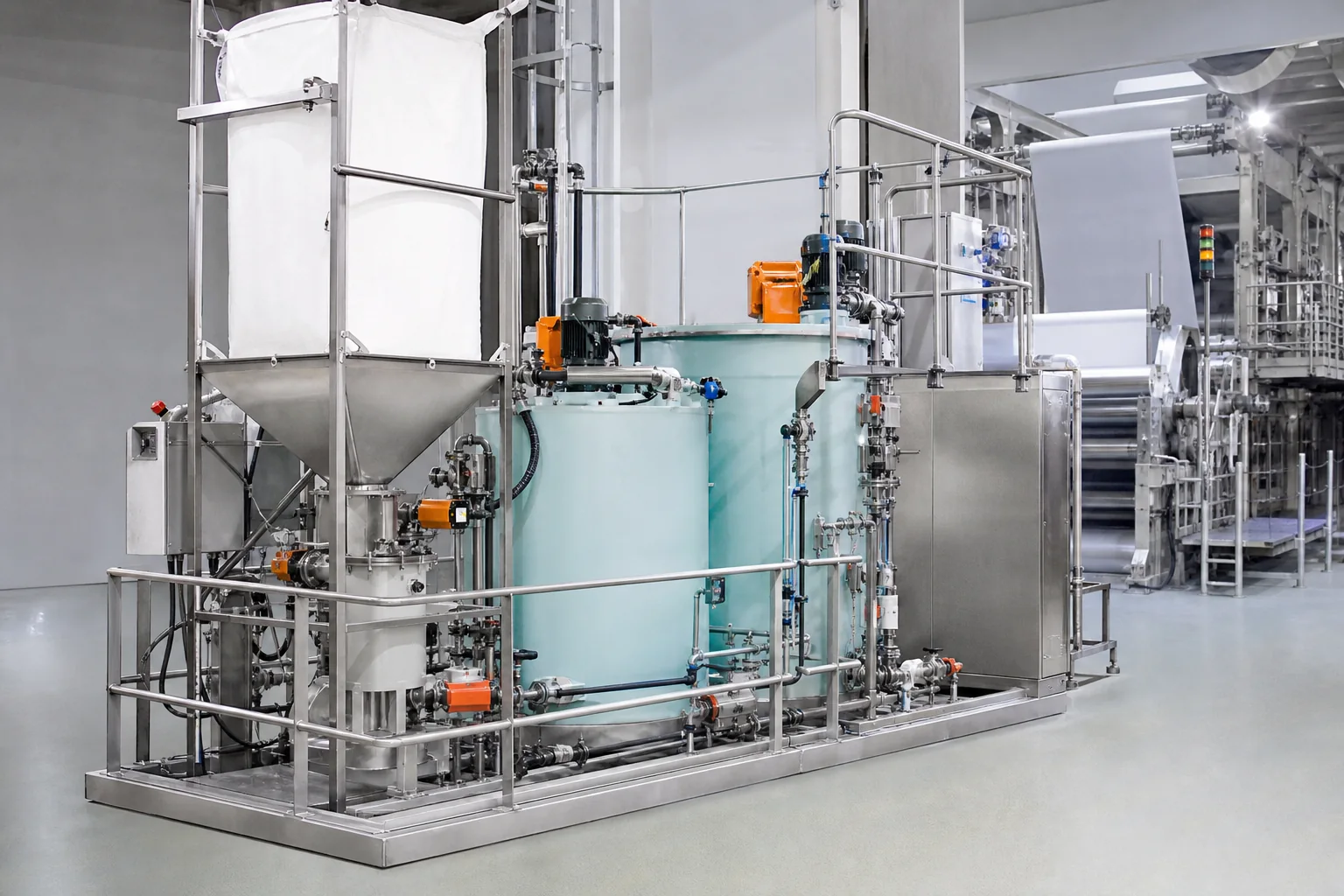
Map the approach flow
Document machine chest, stuff box, fan pump, screens, cleaners, headbox and major recirculation paths.
Mark every current wet-end chemical point.
State the polymer function
Retention, charge control, reflocculation and dry-strength adsorption need different contact and shear conditions.
Do not move a product without defining the intended effect.
Check stock consistency
Record consistency and flow at candidate points and confirm the dilution system can distribute polymer quickly.
Poor macro-mixing can create local overdose and formation defects.
Protect useful contact
Allow enough contact for adsorption while avoiding long uncontrolled interaction with contaminants.
The correct delay depends on furnish and the full chemistry sequence.
Account for shear
Identify whether the polymer should act before shear, survive shear or work as a reflocculant after shear.
Reproduce the relevant path in the laboratory.
Respect other additives
Evaluate coagulant, starch, sizing, filler and microparticle order when moving the PAM point.
A better isolated PAM response can disrupt another wet-end function.
Trial one point at a time
Hold active addition stable, establish a baseline and compare retention, drainage, formation and white-water response.
Allow system carryover to clear before sampling.
Document the final point
Record pipe location, injection hardware, dilution, mixing, delay, shear and operating range.
Recheck after approach-flow or wet-end program modifications.
Machine-trial interpretation and release record
A useful paper-machine decision record connects the product question to a defined furnish and grade. Record fiber mix, fines, filler, broke, pH, conductivity, temperature, charge demand and the complete wet-end additive sequence. Identify the current limitation and the measurement that will decide the trial. This context prevents a visually attractive laboratory result from being mistaken for a production-ready recommendation.
Compare a blank, the current program and coded candidates at equal active addition. Keep stock consistency, dilution water, polymer aging, addition order, mixing energy and elapsed time consistent. Measure the relevant combination of total and ash retention, drainage, white-water solids, formation and sheet properties. Repetition matters when furnish variability is large, and an apparent improvement should remain visible against the reference before scale-up.
The machine review should trace polymer from make-down to the headbox or selected sheet-strength addition point. Note feeder calibration, stock concentration, aging, dilution, injection hardware, contact time, fan-pump and screen shear. A chemistry that works only under gentle beaker mixing may not survive the approach-flow path. Conversely, poor wetting or a blocked dosing line can make a suitable grade appear ineffective.
Approve an operating window, not a universal dose. State the furnish, paper grade, test methods and acceptable balance among retention, drainage, formation, runnability and finished-paper quality. Link the approved sample code to its quotation, COA, SDS, packaging and receiving checks. Revalidate after meaningful changes in furnish, filler, wet-end chemistry, addition point, machine speed or supplied product identity.
Plan the machine trial before the sample arrives. Define baseline duration, sampling points, laboratory methods, operator observations, stabilization time and stop conditions. Hold other additives steady when practical, and document every unavoidable process change. Review white water, press behavior, deposits, broke and finished-paper tests beside the primary metric. A trial succeeds only when the total process and quality balance remains acceptable, not when one retention or drainage reading briefly reaches a peak.
Close the work with a release sheet that production, quality and purchasing can all use. Include the accepted product code, active addition range, preparation recipe, addition point, monitored signals and corrective actions. Add the representative furnish window and approval date. This lets later lots be checked against the same evidence and prevents a result from being separated from the conditions that created it.