
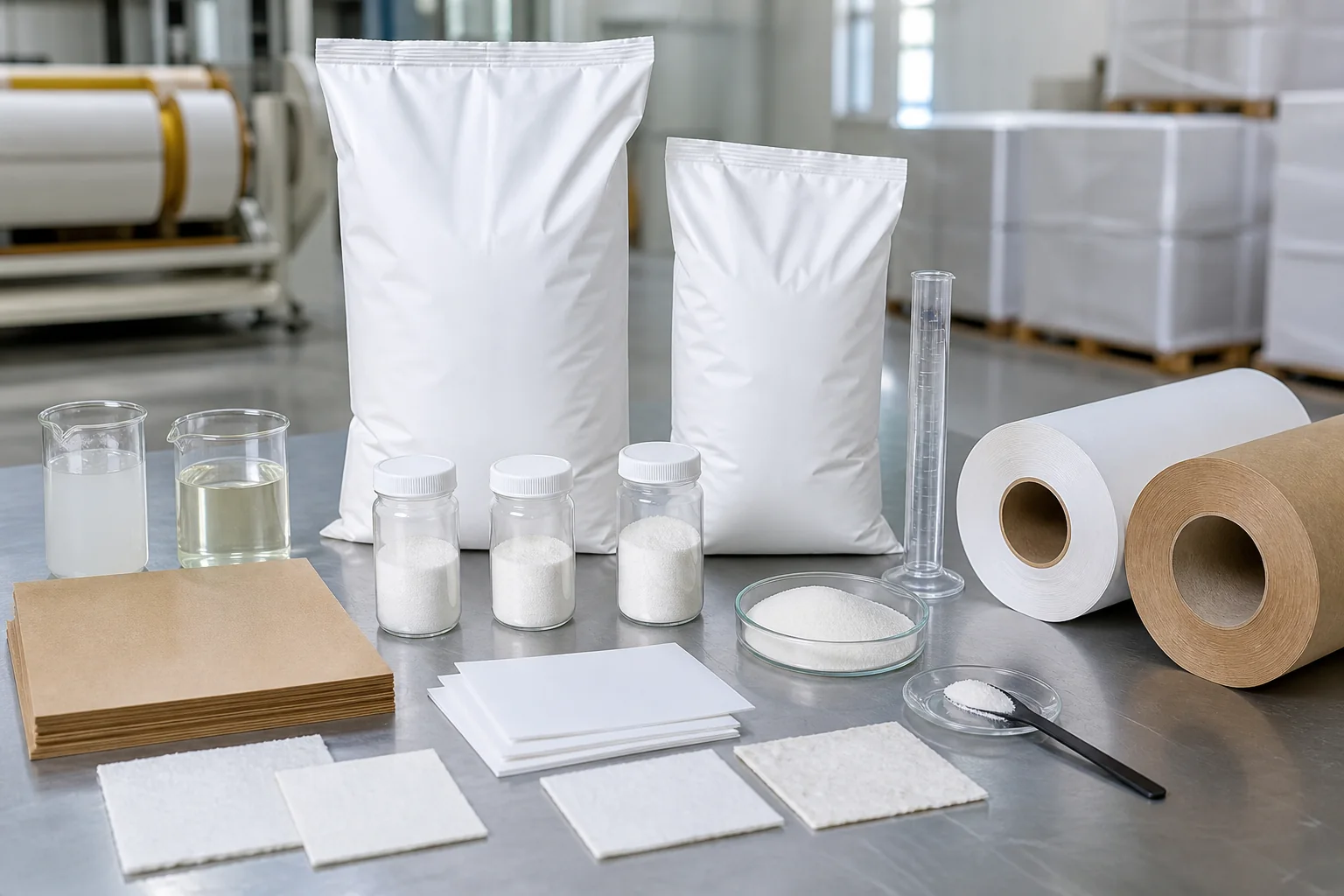
Separate sample screening from a production trial
A small laboratory sample can support furnish screening but may not cover a stable machine comparison. Identify candidate count, paper grade, planned additions and the production periods required for baseline, candidate and repeated points. Ask for product preparation and concentration information before deciding a bag or drum quantity.
Confirm the dose denominator: dry fibre, agreed paper output or another explicitly defined basis. Wet stock flow alone is not enough to estimate consumption. State any uncertainty in the trial schedule or furnish availability so dispatch is not mistaken for a completed qualification plan.
Calculate the stable-period requirement
For active addition D in kilograms per agreed tonne, production rate R on the same tonne basis per hour, duration H and active fraction a, supplied-product mass is D × R × H ÷ a. Use the supplier's documented product basis rather than assuming nominal solids equal active content.
For arithmetic illustration only, D = 0.5, R = 20, H = 6 and a = 0.9 require about 66.7 kilograms of supplied product. These values are not a recommended dose, assay or machine schedule. Keep any conversion between fibre and finished-paper bases visible.
Allow for loop response and preparation
Add justified material for tanks and lines, preparation losses, product transitions and repeat conditions. Confirm the quantities and stabilization plan with the installed system. A white-water loop or additive carryover can make early samples unsuitable for steady-state ranking even while the machine continues to produce paper.
Identify how breaks, grade changes or interrupted periods affect the schedule. Do not simply average them into a favorable usage result. Include retained samples and package increments while avoiding excess stock that cannot be stored or used within the documented conditions.
Release dispatch against readiness and identity
Link sample, trial package, preparation instructions and quotation to the proposed production code. Confirm the mill's operators, laboratories, water, dosing equipment and agreed quality gates before shipment. Keep technical services and chemical quantity distinct unless both are explicitly included in the offer.
After the trial, reconcile actual supplied use with valid production intervals and accepted paper quality. Preserve rejected and transition periods. If a difficult furnish was not available, define a bounded follow-up order rather than treating the first shipment as approval for every grade and operating condition.
Connect qualification to the order
Keep the related operating qualification with the purchase record. Further checks include Papermaking PAM First-Lot Acceptance: Match the Shipment to the Trial and Changing a Paper PAM Supplier: Plan the Crossover Around Grade and Loop Stability.
Request coded material through the papermaking PAM sample and quotation brief. Include paper grade, furnish, additive sequence, preparation limits, acceptance method, quantity and destination. Separate demonstrated results from conditions still awaiting a trial.