
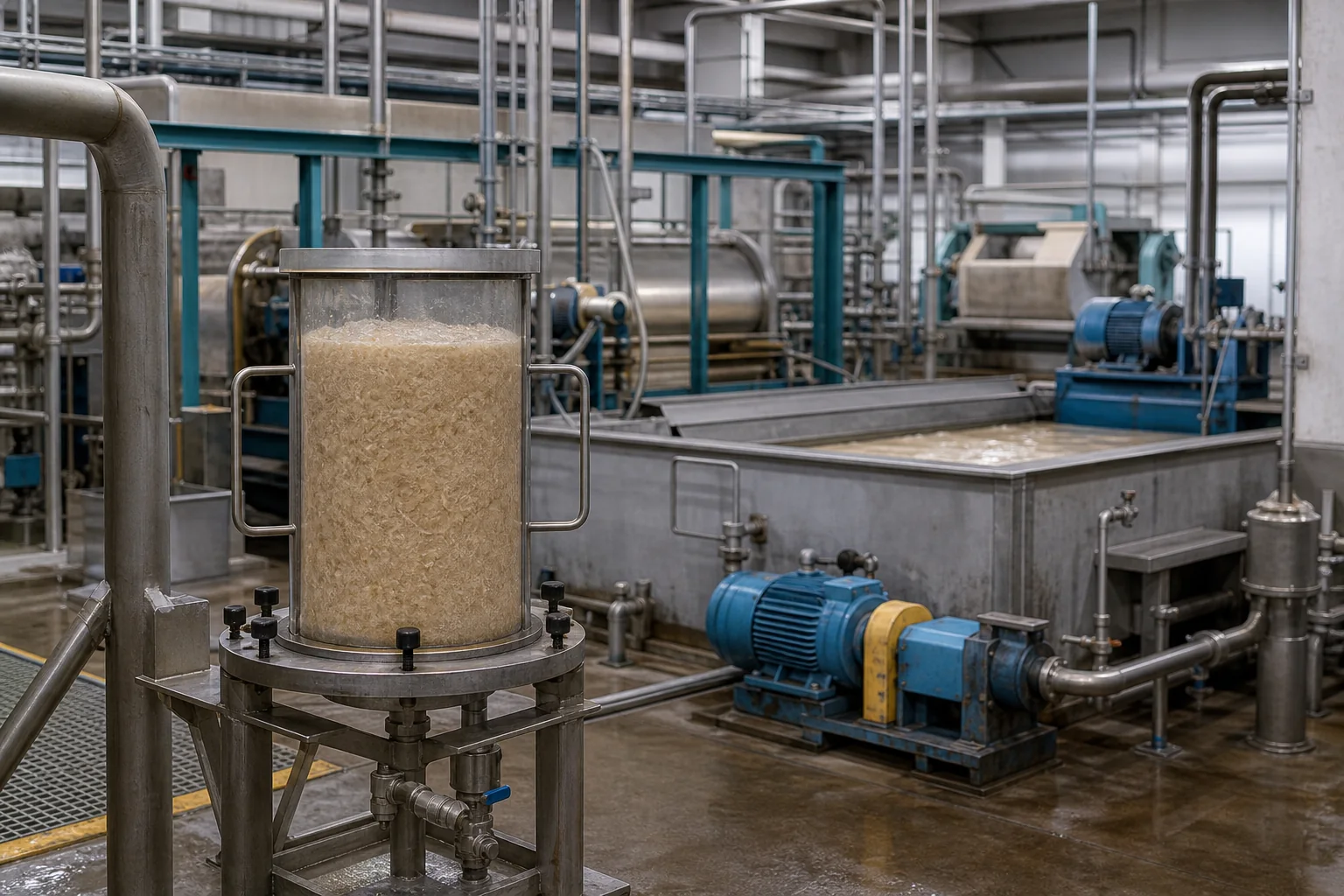
Describe the operating water, not only fresh dilution water
A closed or increasingly closed paper-water loop can change conductivity, dissolved material and the load reaching the retention system. Record representative trends, fresh-water contribution, broke and grade changes. A test prepared with clean laboratory water may not reproduce the furnish used to justify a new CPAM order.
Keep the measurements and sampling points consistent. Conductivity gives useful context but does not identify every charged species or replace the mill's charge method. Ask the supplier to relate its shortlist to actual stock and water conditions rather than quote a universal high-conductivity grade.
Preserve the complete chemical sequence
List fixation, coagulation, starch, sizing, retention and microparticle components with their addition points. Compare candidates at the same confirmed active basis and realistic preparation, contact and shear. Control the variables that can otherwise make an apparent polymer response a water or sequence effect.
Where an additional charge-control adjustment is proposed, test and price that scope separately. Do not accept a lower retention-polymer dose as proof of lower program cost if another component or water-treatment requirement rises. A conditional operating limit belongs in the proposal.
Test the useful range rather than one favorable point
Include normal and credible difficult water conditions in the qualification matrix and retain the incumbent. Read retention, drainage, white-water solids, formation and grade-critical properties together. The preferred product should have an operating window the mill can monitor and control, not a narrow laboratory optimum that shifts with routine loop variation.
During machine confirmation, record the timing of process changes and allow recirculating effects to clear before comparison. A brief stable reading cannot establish behavior over an untested closure level. Avoid assigning savings to a future water reduction before the quality and operating trial supports it.
Make control assumptions part of supply acceptance
The RFQ should identify the demonstrated conductivity and charge context, water use, grade range, preparation capacity and required methods. Request traceable samples and current documents. Identify the measurements that trigger investigation rather than an automatic chemical-feed increase.
Keep the accepted code linked to its water and chemistry envelope. Re-screen after meaningful closure, source-water or additive changes. This provides purchasing with a defensible supply boundary without pretending that the polymer alone controls every consequence of a closed-water system.
Connect qualification to the order
Keep the related operating qualification with the purchase record. Further checks include Retention Polymer for Coated Broke: Define Carryover Before Comparing Quotes and Retention PAM for High-Speed Paper Machines: Request Post-Shear Bid Evidence.
Request coded material through the papermaking PAM sample and quotation brief. Include paper grade, furnish, additive sequence, preparation limits, acceptance method, quantity and destination. Separate demonstrated results from conditions still awaiting a trial.