
Confirm the proposed identities and product forms
A powder-to-emulsion proposal changes more than package handling. Confirm the offered code, documented active basis and specific preparation method. Liquid products can use different activation arrangements, so do not assume that every emulsion requires the same equipment or that all are suitable for direct addition.
State why the mill is considering a change, such as preparation consistency, footprint or handling labor. Keep those objectives separate from retention and sheet quality. The proposed form still needs to pass the furnish and machine qualification; easier handling does not establish chemical equivalence.
Evaluate the installed preparation route
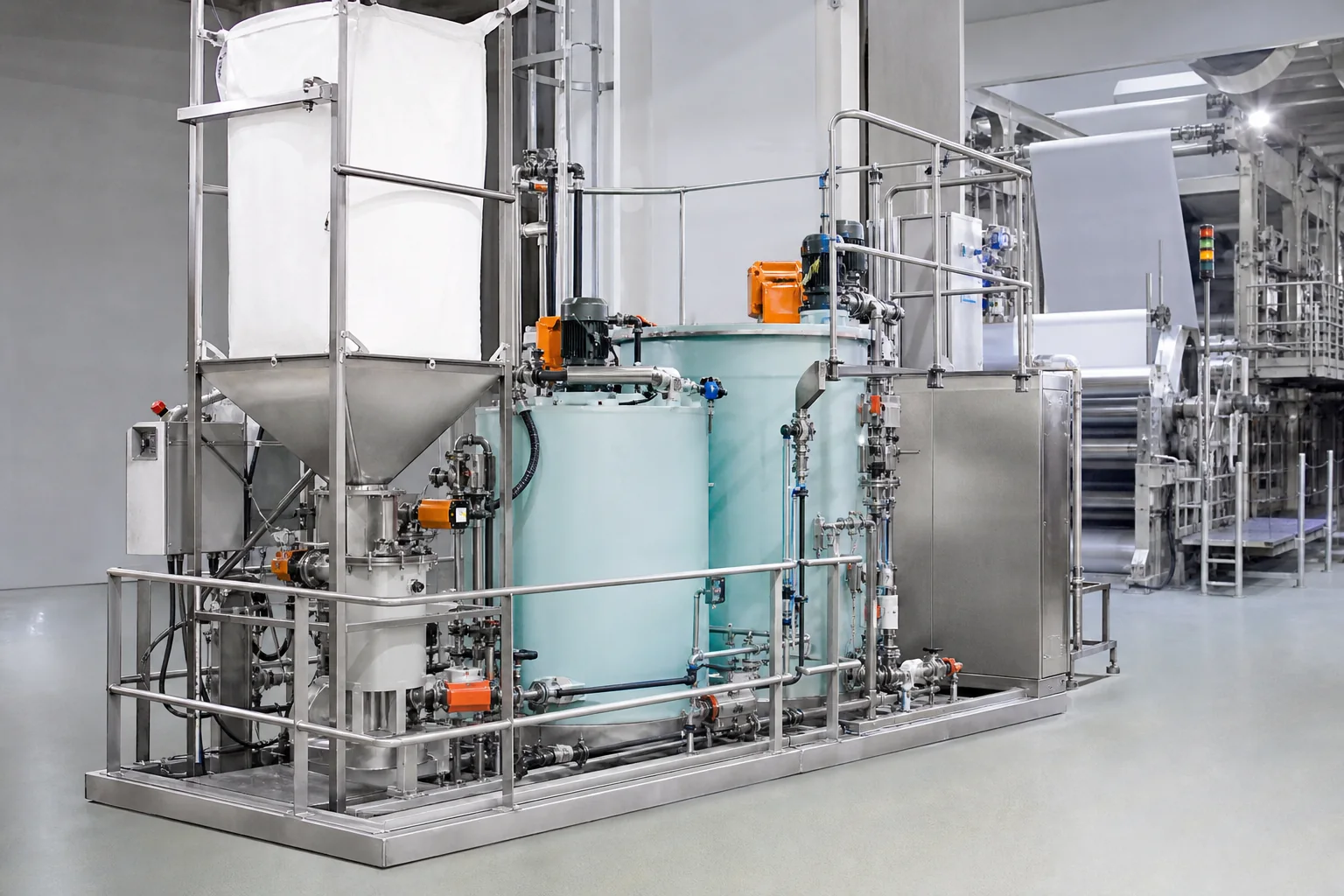
For powder, record feeder turndown, wetting, usable aging volume and solution withdrawal. For the liquid candidate, obtain code-specific activation or inversion instructions and compare them with available water, mixing and metering. Use the real dilution-water condition and production rate rather than an unusually patient laboratory method.
Inspect solution consistency and preparation limits before attributing a different machine response to polymer chemistry. If the proposal needs new pumps, tanks or controls, qualify and price that change explicitly. Higher active content does not compensate for poor dispersion or an unsuitable activation route.
Compare active addition within the full wet end
Use the same furnish, chemical sequence and relevant shear history for candidate and incumbent. Read total and ash retention with drainage, white-water load, formation and grade-critical sheet properties. A conveniently prepared product is not an acceptable replacement if its operating window is too narrow or its floc harms formation.
Record startup, wash or operator interventions as part of the result. Keep package and preparation losses separate from stable-use consumption. Where the preferred concentration differs, document why it is required rather than comparing equal neat-product volumes as though they contain equivalent polymer mass.
Define the complete conversion offer
Request applicable documents, storage and handling guidance, unloading connections and package disposition. Follow the SDS and mill procedures for each actual product. Separate chemical supply from equipment, commissioning and service commitments instead of leaving the changeover responsibility implicit.
Order a bounded evaluation quantity with a clear link from sample to production code. Approve the form, preparation and machine window together, retaining the incumbent option until the agreed confirmation is complete. A routine purchase description should not extend the trial result to untested furnishes or another activation system.
Connect qualification to the order
Keep the related operating qualification with the purchase record. Further checks include Cationic PAM Retention Aid: Write a Furnish-Based Purchase Specification and Papermaking PAM First-Lot Acceptance: Match the Shipment to the Trial.
Request coded material through the papermaking PAM sample and quotation brief. Include paper grade, furnish, additive sequence, preparation limits, acceptance method, quantity and destination. Separate demonstrated results from conditions still awaiting a trial.